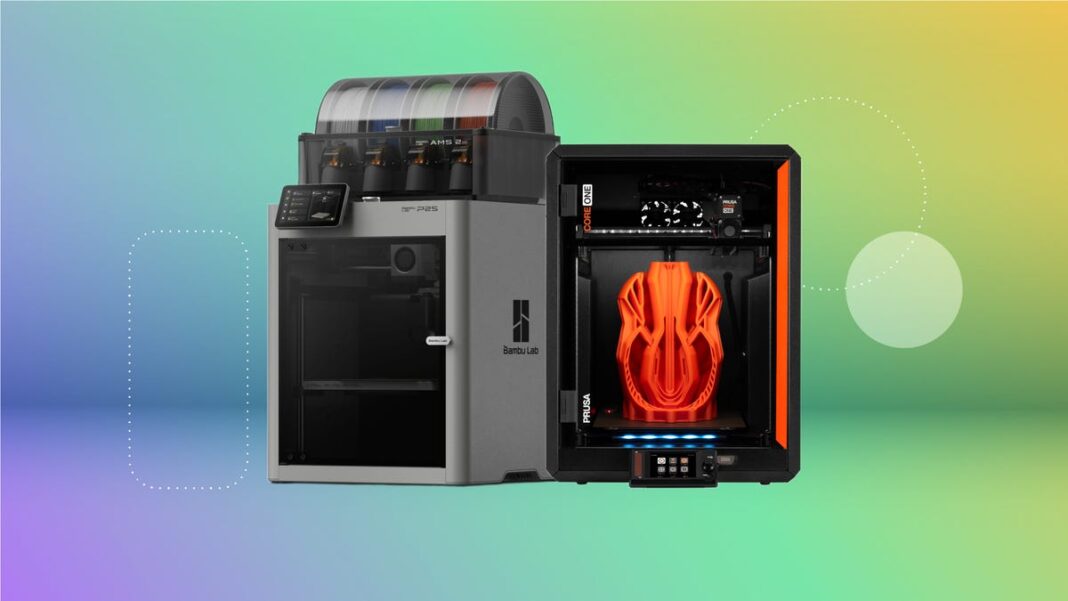

Testing 3D printers is an in-depth process. Printers often don’t use the same materials, or even the same process to create models. I test SLA, 3D printers that use resin and light to print, and FDM, printers that melt plastic onto a plate. Each has a unique methodology. Core qualifiers I look at include:
- Hardware quality
- Ease of setup
- Bundled software
- Appearance and accuracy of prints
- Repairability
- Company and community support
A key test print, representing the OG CNET logo, is used to assess how a printer bridges gaps, creates accurate shapes, and handles overhangs. It even has little towers to help measure how well the 3D printer handles temperature ranges.
When testing speed, we slice the model using the standard slicer the machine is shipped with on its standard settings and then compare the real-world duration of the print to the statement completion time on the slicer. 3D printers often use different slicers, and those slicers can vary wildly on what they believe the completion time to be.
We then use PrusaSlicer to determine how much material the print should use and divide that number by the real-world time it took to print, giving us a more accurate number for the speed in millimeters per second (mm/s) that the printer can run at.
Every build plate is supposed to heat up to a certain temperature, so we use the InfiRay thermal imaging camera for Android to check how well they do. We set the build plate to 60 degrees Celsius — the most used temperature for build plates — waited five minutes for the temperature to stabilize, and then measured it in six separate locations. We then took the average temperature to see how close the 3D printer got to the advertised temperature.
Testing resin requires different criteria, so I use the Ameralabs standard test: printing out a small resin model that looks like a tiny town. This helps determine how accurate the printer is, how it deals with small parts and how well the UV exposure works at different points in the model.
Many other anecdotal test prints, using different 3D models, are also run on each printer to test the longevity of the parts and how well the machine copes with various shapes.
For the other criteria, I researched the company to see how well it responds to support queries from customers and how easy it is to order replacement parts and install them yourself. Kits (printers that come only semi-assembled) are judged by how long and difficult the assembly process is and how clear the instructions are.